Hong Kong’s Refugee Asylum Pattern in a Global Context: An Analysis Based on UNHCR Data (1995-2024)
Background
The refugee issue remains a core challenge facing global humanitarian efforts, closely linked to regional conflicts, political instability, and climate-induced migration. As of 2024, ongoing crises, such as the prolonged conflict in Syria, civil unrest in Sudan, and post-war reconstruction challenges in Afghanistan, have resulted in high levels of forced migration, reshaping the global asylum landscape.
According to data from the United Nations High Commissioner for Refugees (UNHCR), the total number of refugees and people in refugee-like situations worldwide has exceeded 35 million.
As an international metropolis, Hong Kong’s data on refugee reception and outflow reflects regional particularities. Through data mining from the UNHCR, we can reveal the true nature of global and Hong Kong refugee movements, providing valuable insights for understanding how this densely populated, rule-based East Asian city responds to global refugee challenges.
Dataset
The primary dataset used for this project was compiled and published by the United Nations High Commissioner for Refugees (UNHCR), which included the number of origin country, asylum country, refugees, and related populations globally throughout 1995 to 2024.
Questions
This news project aims to explore:
Q1: Which are the top five countries in the world that hosted the largest number of “refugees and people in refugee-like situations” in 2024? And which five countries are the main sources of these refugees?
Q2: What changes have occurred in the number of “refugees and people in refugee-like situations” hosted in Hong Kong each year from 2019 to 2024 who received assistance from UNHCR?
Q3: What are the Top 5 sources of “refugees and people in refugee-like situations” in Hong Kong in 2024?
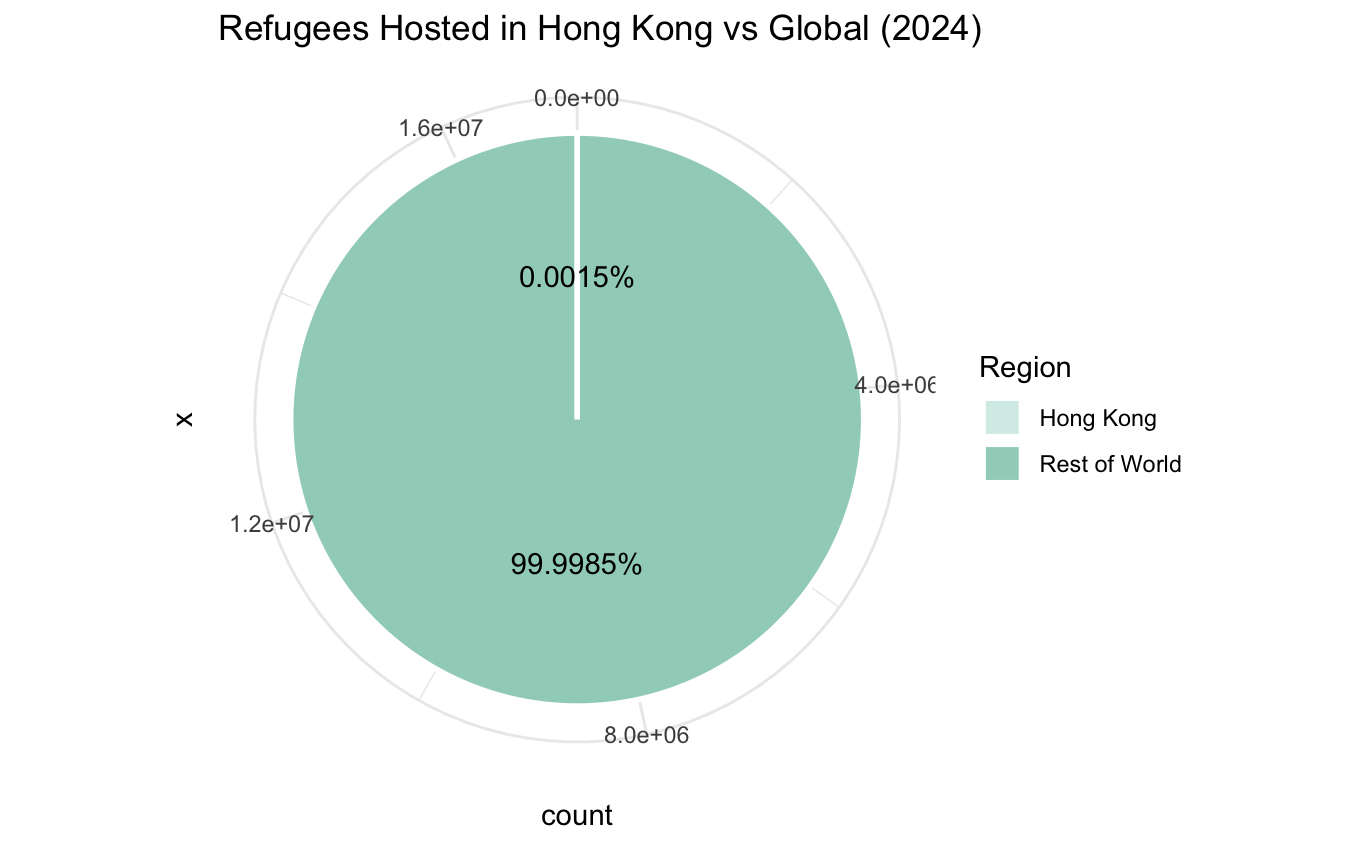
Q4: What percentage of the global total number of “refugees and people in refugee-like situations” does Hong Kong’s hosted refugee population account for in 2024?
Finding 1: Top Refugee Hosting & Origin Countries in 2024
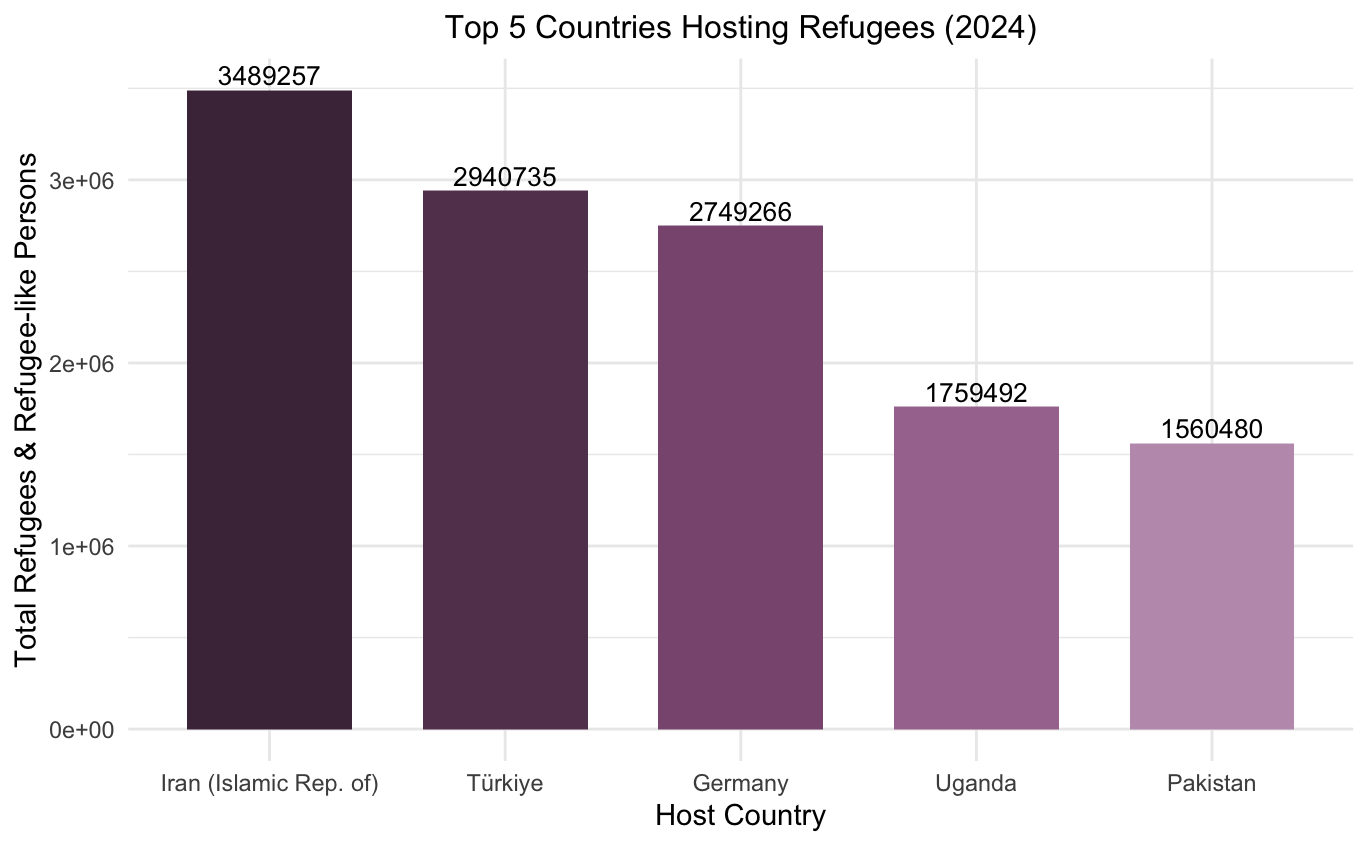
Top 5 Countries Hosting the Largest Number of Refugees
Iran (Islamic Rep. of): 3,489,257
Türkiye: 2,940,735
Germany: 2,749,266
Uganda: 1,759,492
Pakistan: 1,560,480
Top 5 Main Source Countries of Refugees
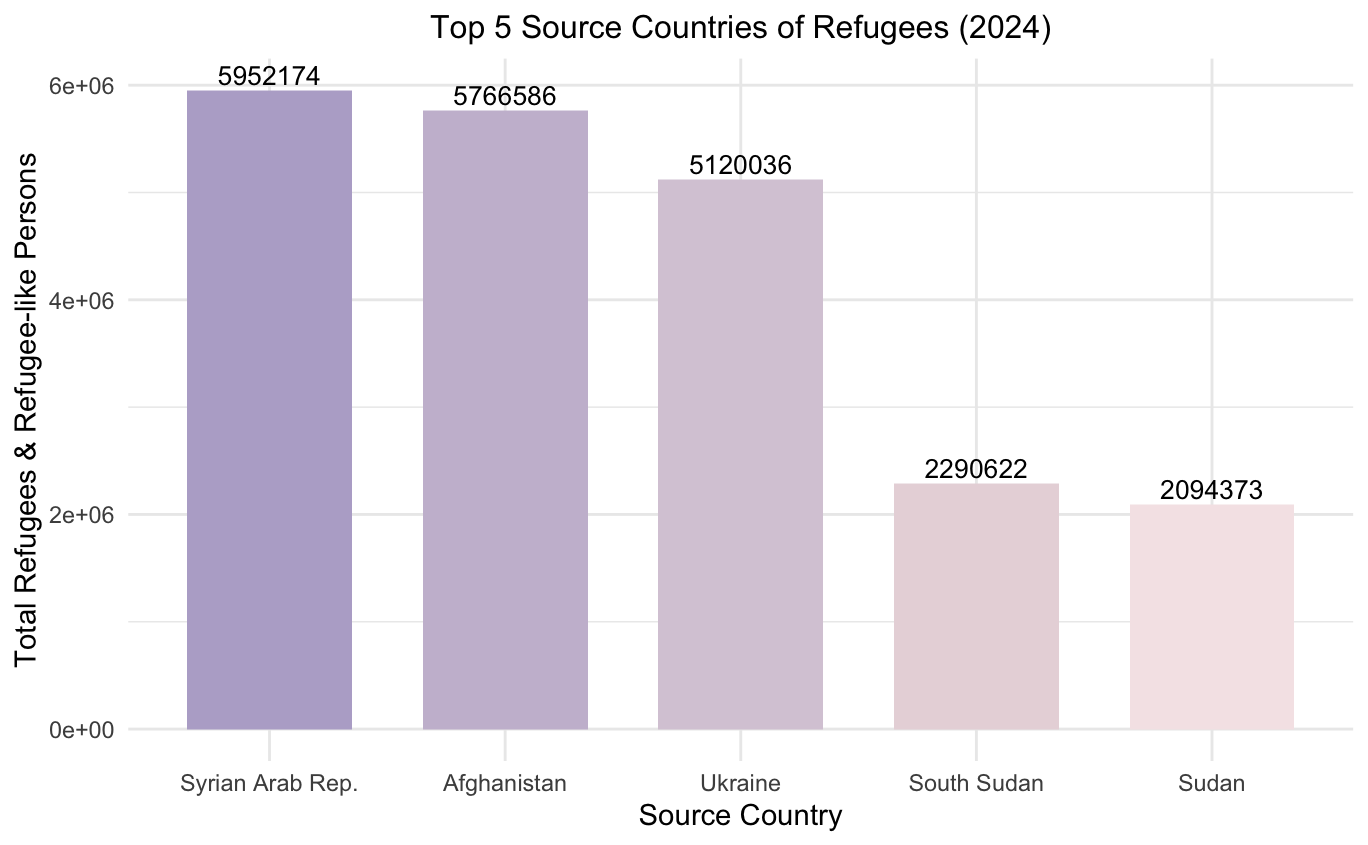
Over 60% of global refugees and refugee-like populations originated from five nations in 2024, driven by protracted conflict, political instability, and humanitarian crises:
Syrian Arab Rep.: 5,952,174
Afghanistan: 5,766,586
Ukraine: 5,120,036
South Sudan: 2,290,622
Sudan: 2,094,373
Finding 2: Trends in UNHCR-Assisted Refugees in Hong Kong from 2019 to 2024
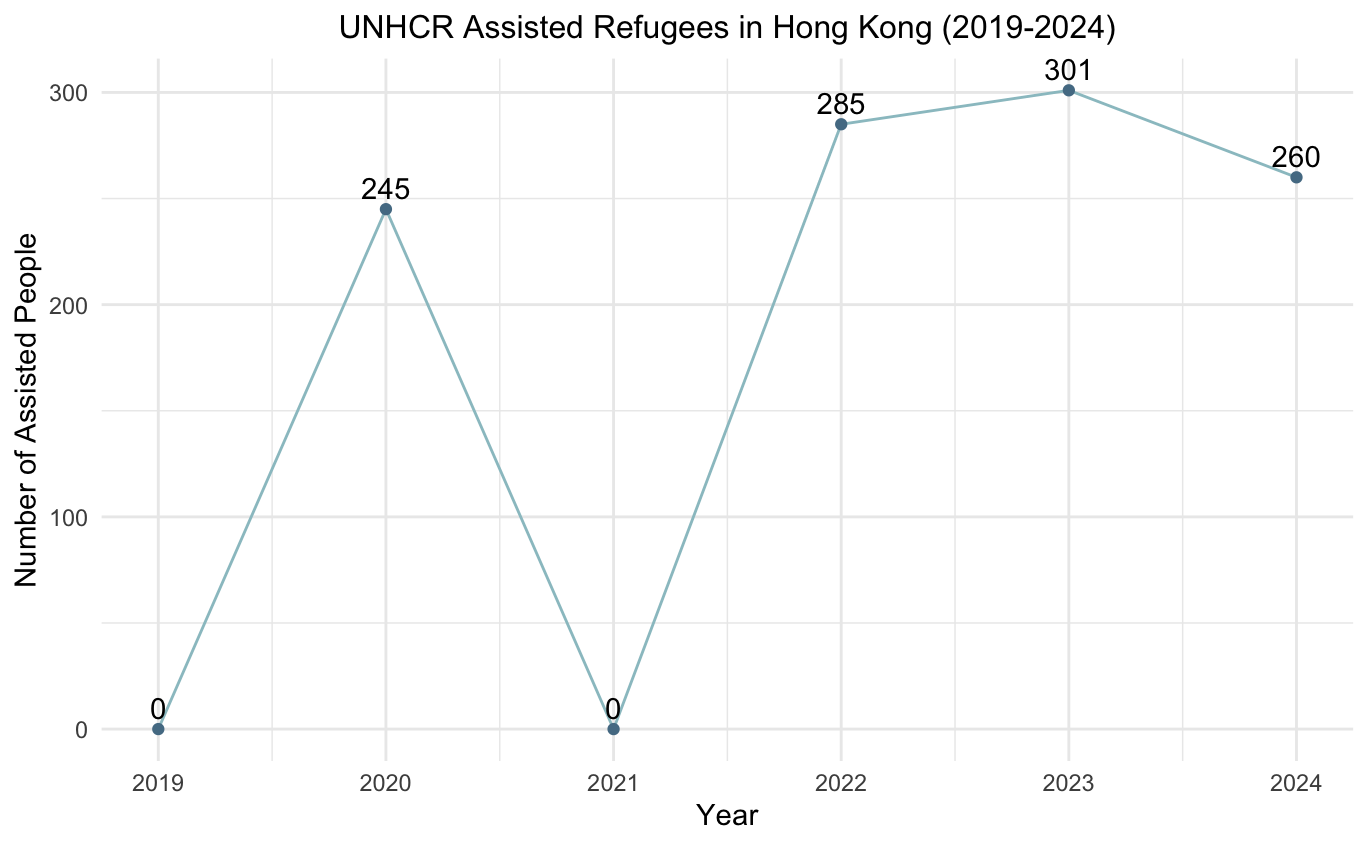
2019 & 2021: No UNHCR-assisted refugees were recorded in these two years.
2020: The population resumed with 245 assisted individuals, marking the first recorded cohort in this period.
2022–2023: Steady growth occurred: the number rose to 285 in 2022, then increased further to 301 in 2023 (the highest figure in the 6-year period).
2024: A moderate decrease was observed, with the assisted population dropping to 260, a 13.6% decline from 2023’s peak.
Finding 3: Top 5 Sources of UNHCR-Assisted Refugees in Hong Kong in 2024
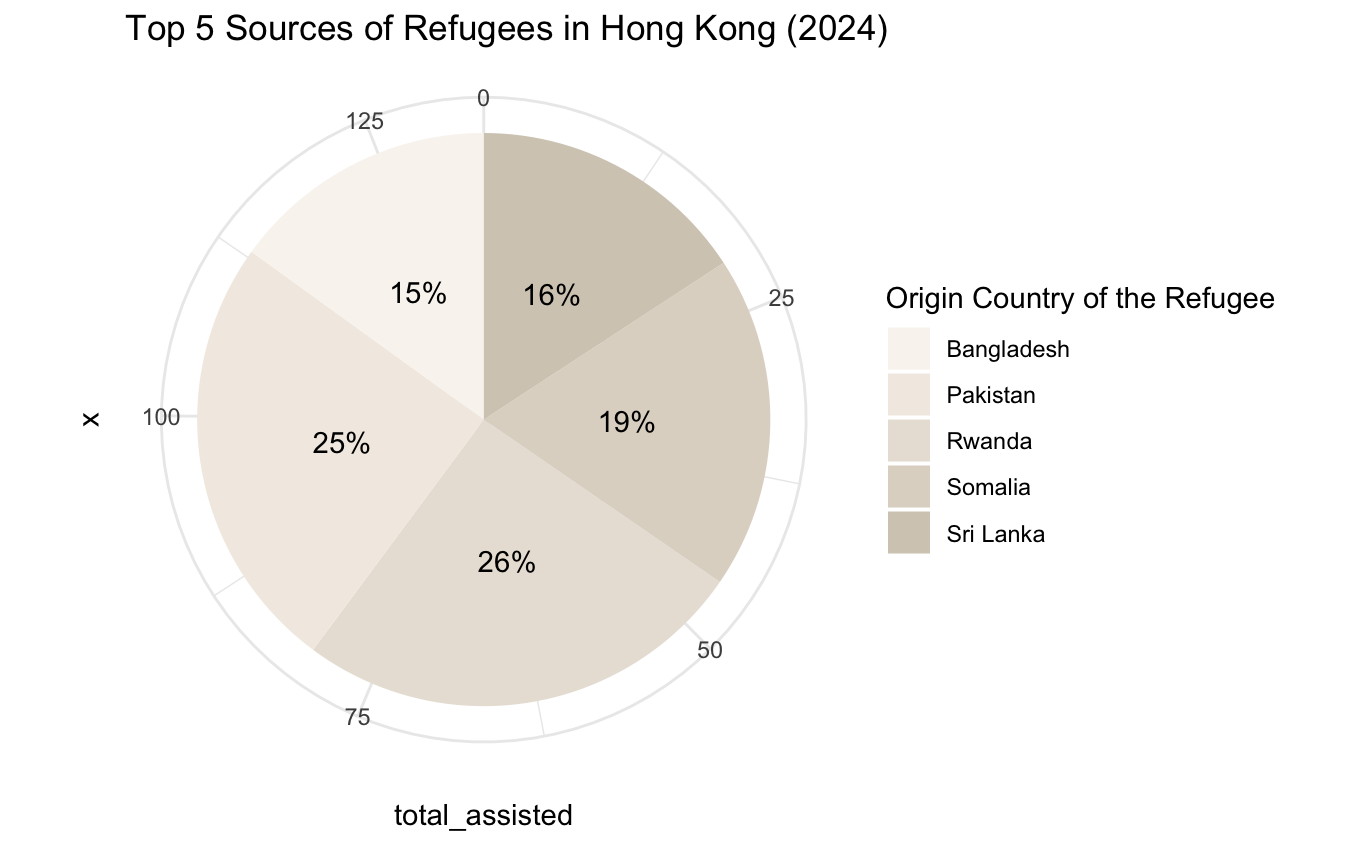
Rwanda: 34 individuals (26% of the total, the largest single source)
Pakistan: 33 individuals (25% of the total)
Somalia: 25 individuals (19% of the total)
Sri Lanka: 21 individuals (16% of the total)
Bangladesh: 20 individuals (15% of the total)
The 2024 refugee population in Hong Kong is concentrated in a small set of origin countries, with the top two sources, Rwanda and Pakistan, making up over 50% of the total. This pattern differs from global refugee origin trends dominated by Syria, Afghanistan, reflecting Hong Kong’s unique regional and administrative context for refugee screening and assistance.
Finding 4: Hong Kong’s Share of Global Refugee Population in 2024
In 2024, the number of “refugees and people in refugee-like situations” hosted in Hong Kong accounted for only 0.0015% of the global total, while the rest of the world hosted 99.9985% of the global refugee population.
Summary:
Globally, refugee hosting remains highly imbalanced, with low to middle income countries shouldering the majority of responsibility, contrasting with the concentration of refugee origins in nations grappling with protracted conflict or acute instability. It can be seen that the pressure of refugee resettlement is concentrating on the geographically neighboring countries. This pattern highlights a lack of equitable global responsibility sharing for displaced populations.
In Hong Kong, the UNHCR-assisted refugee population exhibits no steady long-term trajectory, instead fluctuating over the 2019–2024 period, with intermittent gaps in recorded cases and a recent slight decline after a short growth phase. Notably, Hong Kong’s share of the global refugee population is negligible, positioning it as a minor participant in global refugee hosting.
In conclusion, the refugee data is not merely a presentation of figures. It is a concrete manifestation of the imbalance in global governance and the differentiation of regional roles. At the global level, there is an urgent need to establish a fairer responsibility sharing mechanism and enhance support for middle and low income countries that receive refugees.